Steak Doneness Temperature Chart From Rare to Well Done
Senior Editor
Pull a 1 to 1½ inch steak off the heat about 5°F below the doneness you want, and rest it. For medium rare, that means pulling at 125 to 130°F so it finishes at 130 to 135°F. The chart below has every step from rare to well done, with both numbers: the one to pull at, and the one you'll eat.
Two things decide whether you hit it. The first is where the probe sits: the centre of the thickest part, slid in from the side. The second is carryover: a steak keeps cooking after it leaves the pan, by a few degrees for a weeknight steak and more for a thick one. Both are below, along with the one number food safety adds.
| Doneness | Pull it at | It finishes at |
|---|---|---|
| Rare | 115-120°F | 120-125°F |
| Medium rare | 125-130°F | 130-135°F |
| Medium | 130-140°F | 135-145°F |
| Medium well | 140-150°F | 145-155°F |
| Well done | 150-155°F | 155°F and up |
What each one looks like cut open:
The finished ranges are the ones most butchers, steakhouses and thermometer makers publish; they overlap a little at the edges because people disagree about where medium ends. The pull column is our own call for a 1 to 1½ inch steak seared in a hot pan, built on the 3 to 5°F carryover such a steak usually picks up while it rests. Adjust it for thickness, below.
If you cook for people who want different steaks, the pull temperature is the one to write down. Take the rare steak off first, keep the others going, and they'll all land at once.
Slide the probe in from the side, parallel to the board, until the tip sits in the middle of the thickest part. Going in from the top on a steak barely an inch thick puts the tip too close to the hot pan side and reads high, so you pull it early.
Keep the tip away from bone and from a seam of fat; both read differently from the meat around them. On a T-bone or a bone-in ribeye, go into the thick part of the eye, an inch away from the bone.
Take two readings in slightly different spots and trust the lower one. A fast instant-read thermometer makes this a three-second job; a slow one tempts you to leave the steak on the heat while you wait, which is how medium rare turns into medium. If your readings look off, check the thermometer in ice water first: it should read 32°F.
A seared steak is hotter on the outside than in the middle when it comes off the heat, and that heat keeps moving inward while it rests. The centre goes on rising for a few minutes, then levels off.
How far it climbs depends mostly on thickness and on how hot you cooked it:
Rest the steak 5 minutes on a board or a rack. Longer doesn't hurt, but it doesn't help the juices either: the point of the rest is the carryover, and that's done in about five.
Thin steaks (under ¾ inch), like skirt and thin-cut sirloin. Get the pan as hot as it goes, sear a minute or two a side, and check early. By the time a thin steak has a good crust it's usually at medium rare already. Cast iron is the right pan for this: it holds its heat when the cold meat lands, so the crust forms before the middle overcooks. We go through why in cast iron, stainless or nonstick.
Weeknight steaks (1 to 1½ inches), like strip, ribeye and sirloin. Pat dry, salt, sear in a hot pan and flip every minute or so for an even inside. Start checking a couple of minutes before you expect it to be done, and pull at the chart's number. The full method, including the pan sauce after, is in how to sear a steak in a cast iron pan.
Thick steaks (2 inches), like a big ribeye or a porterhouse. Reverse sear: a 250°F oven until the centre is about 15°F under the finish you want, then a minute a side in a very hot pan. A leave-in probe thermometer does the oven part for you: set the alarm, close the door, and it beeps when the steak gets there.
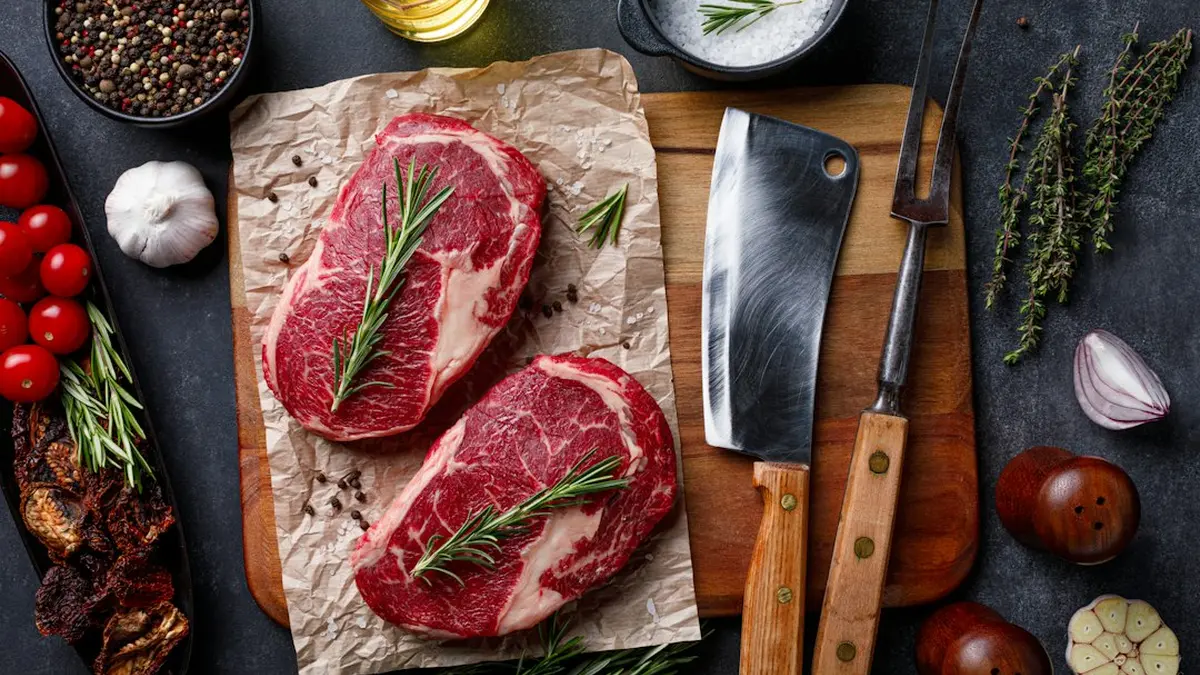
There's no wrong answer at your own table, but the cuts do behave differently:
The USDA's Food Safety and Inspection Service puts the safe minimum for whole cuts of beef, pork, veal and lamb at 145°F with a 3 minute rest (FSIS safe temperature chart). On the chart above, that's medium well. Rare, medium rare and medium all sit below it, and anyone who's pregnant, very young, older or has a weakened immune system should keep to the 145°F line.
Two kinds of beef don't get the steakhouse exception at all. Ground beef is 160°F, because grinding spreads whatever was on the surface all the way through. And mechanically tenderized steaks, pierced with blades or needles to soften them, carry the surface inside the same way; FSIS requires them to be labelled as such and recommends cooking them to 145°F with the rest. If the label says "mechanically tenderized" or "blade tenderized", treat it like that.
Our safe internal temperature chart has the full list, from chicken to fish.
A steak is the one dinner where a fast thermometer changes the result: the difference between medium rare and medium is a minute in a hot pan. The ThermoWorks ThermoPop 2 is the one we'd buy first; the Thermapen ONE is faster and worth it if you cook meat most nights. We compare the two in ThermoPop 2 vs Thermapen ONE. For the pan, a heavy 12 inch cast iron skillet does the searing.
One email a week with what we published. No spam, nothing sold, unsubscribe in one click.
Comments
No comments yet. Be the first to comment!
Leave a Comment