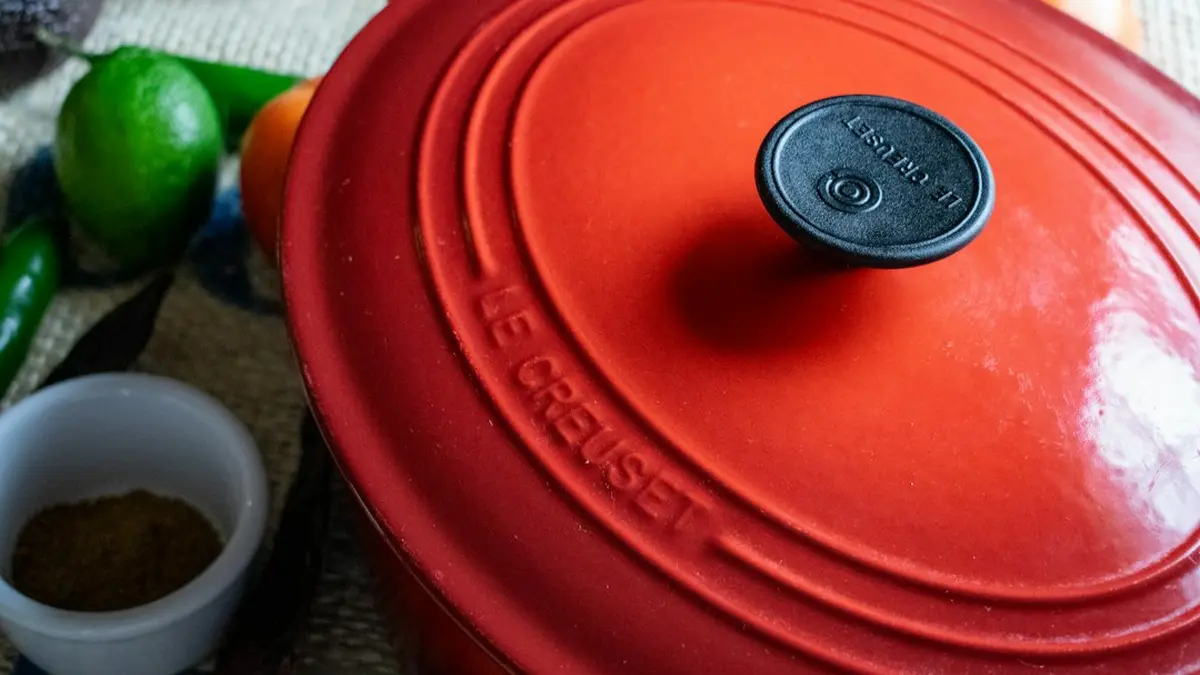
For an ordinary 3.5 to 4.5 pound supermarket chicken, a 5.5 to 6 quart round Dutch oven holds it with the lid on. A 5 to 6 pound bird needs 7 quarts or an oval pot. Matching the pot takes five minutes with a tape measure, and one thing matters before you start: the width of the pot's base tells you more than the quart number on the box.

What you need

  • The chicken, with its label

    Use the package weight. That is the ready-to-cook weight, which is what USDA classes are based on.

  • The Dutch oven you own, or the one you're considering

    Most supermarket birds fit a 5.5 to 6 quart round. Choose 7 quarts or an oval if you often buy large birds.

  • A tape measure or ruler

    You will measure across the inside floor of the pot, not the rim.

  • An instant-read thermometer

    Needed for the doneness check at the end.

If you are buying a pot, two named options fit the ranges above. The Lodge 6 Quart Enameled Cast Iron Dutch Oven is the right size for a standard bird. Hero Cookware did note that Lodge's 6-quart is noticeably narrower inside than a Tramontina 6.5-quart, so measure the base before you commit to a larger chicken. For big birds, the Le Creuset Signature 6.75 Qt Oval Dutch Oven is the better choice. America's Test Kitchen compared a 6¾-quart Le Creuset oval against its preferred 7¼-quart round and found it browned and roasted just as evenly, as long as it was properly preheated.

Matching the bird to the pot

There is a case for skipping all this and buying one big pot. America's Test Kitchen calls a 7-quart the best option for most people, with ample room "from a whole chicken to a batch of baked ziti." That is sound advice, but a full 7-quart cast iron pot is heavy to lift. Hearth and Patina cites handling when full as a real reason not to oversize. Most supermarket chickens are broiler-fryers, which USDA FSIS defines as 2.5 to 4.5 pounds ready-to-cook, and those do not need a 7-quart pot. Work it out for the bird you actually buy.

  1. Read the weight on the label

    Write it down. Under 4.5 pounds is a broiler-fryer. FSIS defines 5 pounds or more as a roaster.

  2. Pick the quart size from the weight

    Hero Cookware's table puts a 4 to 4.5 pound bird at 6 quarts round, a 4.5 to 5.5 pound bird at 6 to 7 quarts, and a 5.5 to 6.5 pound bird at 7 quarts oval. You now have a target size.

  3. Measure the inside floor of the pot

    Hero Cookware puts a standard 5-quart at about 9.5 inches across the base and a 6-quart at about 11. If yours measures closer to 9.5, treat it as the smaller size, whatever the label says.

  4. Set the raw bird in the empty pot

    Truss it first if you plan to. You should see at least 1 inch of space between the bird and the wall on every side. Hero Cookware gives 1 inch as the minimum and 1 to 2.5 inches as the useful range.

  5. Put the lid on

    It should sit flat with no rocking. A lid that closes is only the minimum test. Hero Cookware's point is that closing and cooking well are separate thresholds, so the clearance from the previous step still matters.

  6. Add room for vegetables if you want them

    Shun Grill suggests 1 to 2 extra quarts for vegetables around the bird. If carrots and potatoes will not fit without pressing against the chicken, cook them separately.

  7. Cook, then check doneness in two places

    In America's Test Kitchen's French Chicken in a Pot, a 3.5 to 4.5 pound bird takes about an hour and a 5 to 6 pound bird closer to two. Push the thermometer into the thickest part of the breast, then into the thigh. Check the reading against the current USDA FSIS safe minimum temperature for poultry. The sources gathered for this page don't state that number, so this page doesn't give one.

When the fit is wrong

The bird was touching the walls. Tatnuck Meat & Sea links undersized pots to uneven cooking and skin sticking to the pot. Next time, check for that 1 inch of clearance, or use a smaller bird.

No. America's Test Kitchen developed its pot-roast recipe for 5 to 8 quarts, with one condition: in a 5-quart, keep the bird at 5 pounds or under.

Somewhat. Tatnuck Meat & Sea warns that an oversized pot can steam the chicken instead of roasting it, which costs you crisp skin. Fill the space with vegetables, or accept softer skin when the lid is on.

If the bird is long rather than wide, an oval pot often solves the problem. The trade-offs with oval pots on a stovetop burner are covered in round versus oval.

You can now look at a chicken's label and know whether it fits the pot on your stove. If a whole bird is more than a weeknight allows, the same pot handles bone-in thighs in about 45 minutes.