How to Braise Chicken Thighs on a Weeknight
Contributing Writer
You have a pack of bone-in, skin-on chicken thighs and a pot with a lid, and that is genuinely all this takes. This page walks one braise end to end: brown the skin, build a little liquid under it, put the lid on, and come back to chicken in a sauce you made in the same pan. The reason it works is the thigh itself, and once you understand that, you can braise without a recipe for the rest of your life.
A braise is two moves stuck together: brown the meat in fat over high heat, then cook it gently in a small amount of liquid with the lid on. That is it. The browning builds flavor on the surface; the gentle, moist heat that follows does something to the inside that no amount of high heat can do.
Here is the thing that makes thighs the right cut. Dark meat is full of connective tissue, mostly collagen, which is tough and tight when it is raw and stays tough at low cooking temperatures. FSIS, the USDA agency that sets meat safety rules, puts the safe minimum for all poultry at 165°F, and is clear that this is a safety floor rather than a texture target: at 165°F the collagen in a thigh is still tight, which is why it can read as rubbery even though it is perfectly safe to eat. Past roughly 175°F that collagen starts converting into gelatin, and the conversion is mostly complete somewhere in the 175 to 195°F band. Gelatin is what makes braised meat feel juicy and slip off the bone.
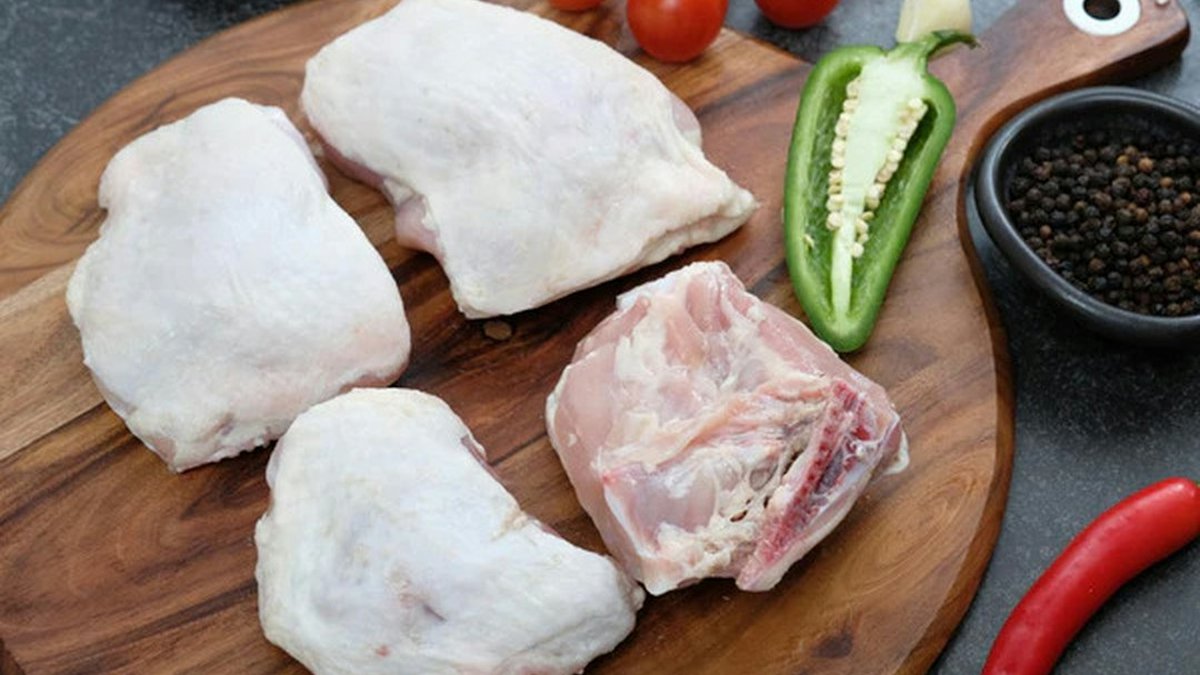
Dark meat has an abundant amount of connective tissue, which dissolves into gelatin as the meat cooks, rendering it juicy and tender.
So a thigh gets better in the exact range where a breast gets worse. America's Test Kitchen calls 175°F very good for thighs and 190 to 195°F optimal for fall-apart tenderness, and only warns you off above 210°F, where the meat turns stringy. Pull a thigh the instant the thermometer says 165 and you have done nothing wrong by the rules and quite a lot wrong by the mouth. Leave it in the liquid another fifteen minutes and the same piece of chicken gives way under a fork. That gap is the entire reason to braise.
Buy bone-in and skin-on, and buy it on price. A 2026 consumer cost guide puts bone-in, skin-on thighs at $1.50 to $3.00 a pound against $3.00 to $5.80 for boneless, skinless, because nobody had to trim them. You are paying less for the cut that braises better, which does not happen often. Chicken has also been quiet: USDA's Economic Research Service reported poultry prices 0.5 percent lower in July 2026 than in July 2025, with a forecast of just 0.5 percent growth across 2026. Nothing about this dinner is going to get more expensive while you learn it.
Feeds four to six. Two published Dutch oven braises use almost exactly this: 3½ lb for six servings, or 8 small thighs at about 3 lb for four.
It needs to hold the thighs in one layer without them touching. If they are climbing over each other, brown in two batches.
FSIS is blunt about this: a thermometer, not time and not color, is the only reliable way to confirm doneness. In a braise, juice clarity tells you nothing at all.
The aromatics: the vegetables you soften in the fat to give the sauce a base.
Low-sodium matters because you are going to reduce it, which concentrates the salt.
For deglazing. Both recipes behind this method use one or the other; neither is required.
Dried herbs are fine. Add them with the garlic, not at the start.
The two published versions run 1 hour 5 minutes and 1 hour 20 minutes door to door. Most of that you are not standing over anything.
A word on the pot, because it is the one thing here you cannot fake. You need something heavy enough to hold its heat when eight cold thighs hit it, wide enough to keep them in a single layer, and able to go from a hot burner into a 350°F oven with a lid on. A cheap thin pan drops temperature the moment the chicken lands and the skin steams instead of browning. One heavy lidded pot covers this braise and most of what you cook on a weeknight.
Heat the oven first so it is ready when you are. I am giving a straight 350°F, which is what the Provençal braise at Leite's Culinaria uses; Well Plated's version instead blasts 450°F for five minutes and then drops to 325°F. Either gets you there. One number is easier to remember.
Dry the thighs hard with paper towel and season both sides with salt and pepper. A wet surface cannot brown until all that water has boiled off, and by then the skin has gone slack. You want the skin visibly dry and matte.
Set the pot over medium-high heat with a film of oil, and lay the thighs in skin-side down. Do not move them for about six minutes. Well Plated's timing is roughly six minutes skin-side down until deeply golden, in batches if the pot is crowded. You should hear a steady sizzle, not a roar and not a hiss. When it is ready the skin releases from the pan on its own; if it sticks, it is not done.
Turn and color the other sides if you want more depth, then take the chicken out to a plate. Leite's browns all sides over medium-high for 10 to 15 minutes total. Skin-side only is faster and perfectly good on a Tuesday. Either way the bottom of the pot should now be covered in brown stuck-on bits. That is fond, and it is the sauce.
Pour off the excess fat, leaving a thin sheen, and add the chopped onion and carrot. Leite's is specific about keeping a little fat behind to cook the aromatics in. Soften them for 2 to 5 minutes, scraping as you go: the onion should go translucent and the fond should start lifting.
Add the garlic, herbs and chilli flakes and cook 30 seconds. Both recipes give garlic exactly this long. You are cooking it until it smells, no further. Garlic burns in the time it takes to answer a question about homework.
Pour in the wine or vermouth, scrape the bottom clean, and let it reduce by about half, roughly three minutes. Well Plated uses ⅔ cup white wine reduced by half over about three minutes, which cooks off the harsh raw-alcohol edge. Leite's uses ½ cup dry vermouth with ½ cup broth. The pan should go from loose liquid to something syrupy and the bottom should be smooth.
Add 1 to 2 cups of broth, return the thighs skin-side up, and check the liquid line. It should come only about halfway up the meat. This is the rule that decides whether the dish works: the browned skin has to sit above the liquid. Submerge the chicken and you have poached it.
Lid on, into the oven for 30 to 35 minutes. Both recipes land in this window. If you want the skin firmer, do what Leite's does and run it 20 minutes covered, then take the lid off for the last 10 to 15.
Check the temperature in the thickest part of a thigh, keeping the probe a fraction of an inch off the bone. FSIS's guidance on chicken is to read the innermost part of the thigh and avoid the bone, which conducts heat differently and reads falsely high. 165°F is the floor. Aim for 175 to 185°F, or push toward 190 to 195°F if you want it falling off the bone. A thin sharp knife should go in, as Well Plated puts it, effortlessly.
Lift the chicken out to a plate and rest it at least three minutes while you finish the sauce. FSIS asks for a minimum three-minute rest on cooked poultry. Put the pot back on the burner and simmer the juices hard for about five minutes until they thicken enough to coat a spoon. Taste for salt now, not before, because reducing it has changed it.
Serve it over something that will take the sauce: polenta, mashed potatoes, rice, wide noodles, or just bread and a green salad. The sauce is the point of the exercise and it should not end up on the plate uneaten.
The skin comes out pale and slippery. You used too much liquid, or you put the chicken back in skin-side down. Both published methods pour broth only about halfway up the meat and set the thighs skin-side up specifically so the browned surface stays out of the liquid. If it has already happened, finish the last 10 to 15 minutes with the lid off, which is how Leite's dries the surface back out.
The skin never browned in the first place. It went gray and stuck. Two causes: wet chicken, or too many thighs in the pot, which drops the pan temperature and turns a sear into a steam. Well Plated's instruction is to brown in batches if the pot is crowded, and that is not fussiness, it is the difference between six minutes of browning and fifteen minutes of nothing.
You pulled it at 165°F and it chewed like a bath toy. This is the most common mistake and it comes from applying breast logic to dark meat. FSIS says plainly that cooking above 165°F is a matter of preference rather than safety, and that thigh collagen is still tight at that point. The fix is to put it back: another ten or fifteen minutes in the liquid costs you nothing, since America's Test Kitchen only puts the ceiling at 210°F, where meat starts going stringy.
The liquid boiled instead of simmering. You will see it: hard rolling bubbles, the sauce reducing to sludge, the meat shredding into dry threads even though it sat in liquid the whole time. A covered pot in a 325 to 350°F oven mostly prevents this, which is the real argument for using the oven rather than the stovetop. On the stovetop you are managing the flame yourself, and the target is lazy bubbles breaking the surface every second or two.
The method does not change. Brown, soften aromatics, deglaze, liquid halfway up, lid, 350°F, 30 to 35 minutes, reduce. Everything else is a swap, and the two recipes this page is built on prove the point by being completely different dishes with the same skeleton: one is white wine, onion and carrot with rosemary or thyme; the other is dry vermouth with lemon, olives and prosciutto added for the final uncovered stretch.
Three swaps worth making early. Drop the alcohol entirely and deglaze with broth alone, keeping your total liquid in the same 1 to 2 cup range. Add something salty and sharp in the last fifteen minutes with the lid off, the way Leite's adds olives, so it keeps its shape rather than dissolving. And if you want a tomato braise, count a can of tomatoes as part of your liquid rather than an addition to it, since neither of these recipes uses tomatoes and the halfway-up rule is the one thing you cannot bend.
Braised chicken also reheats better than almost anything else you will make on a weeknight, which makes a double batch worth the extra pound of thighs. FSIS gives cooked chicken 3 to 4 days in a fridge at 40°F or below, and 4 to 6 months frozen at 0°F, with quality rather than safety as the limit beyond that. Reheating has the same rule as cooking: back up to 165°F, checked with the thermometer. The skin will not be crisp on day two. The sauce will be better.
One email a week with what we published. No spam, nothing sold, unsubscribe in one click.
Comments
No comments yet. Be the first to comment!
Leave a Comment