Where to Insert a Thermometer in a Whole Chicken
Senior Editor
Check a whole chicken in two places: the thickest part of the thigh, close to the bone but not touching it, and the thickest part of the breast. The bird is done when the lowest of those readings is 165°F, the USDA's safe minimum for all poultry (FSIS safe temperature chart).
One spot isn't enough because a chicken doesn't cook evenly. The breast is thick and lean and sits on top; the thighs are tucked in against the body and cook slower. Which one lags depends on your oven and how the bird sits in the pan, so you check both.
The thigh is the slowest part of most birds, so it's the reading that usually decides when dinner is ready.
Don't touch the bone. Bone conducts and holds heat differently from the meat around it, so a probe resting against it gives you a number that isn't the meat's. Don't go into the cavity either: the air in there is not the bird.
Many cooks like thighs well past 165°F, at 175 to 180°F, because the connective tissue in dark meat softens and it eats better. That's a texture choice, not a safety one, and the thighs can take it without drying out.
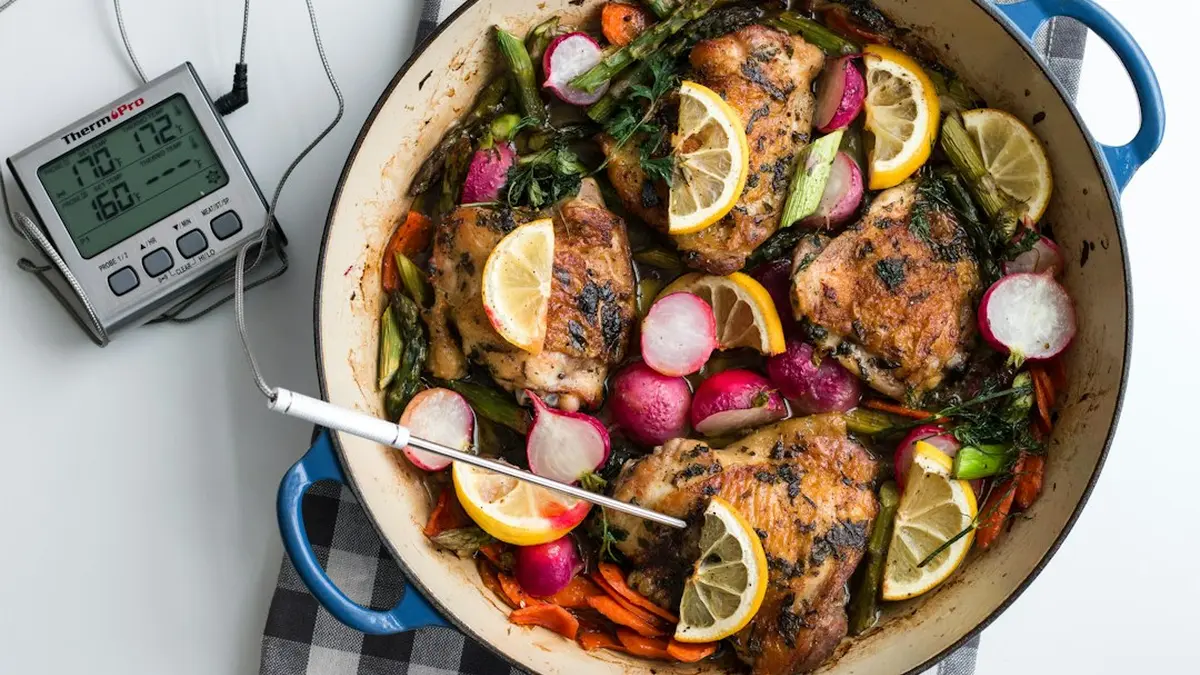
Insert the probe into the thickest part of the breast, near the neck end, going in from the side or front so the tip ends up in the centre of the meat rather than near the bone of the breastbone underneath. On a big bird, check both breasts.
The breast is lean and goes dry fast once it passes temperature, which is why so many roast chickens have perfect legs and chalky breast. If yours keeps finishing well ahead of the thighs, roast the bird breast-side up with the legs toward the back of the oven (the hotter part in most ovens), or spatchcock it so everything cooks at the same depth.
A leave-in probe on a cable lets you close the oven door and wait for an alarm instead of opening it every ten minutes, which drops the oven temperature each time.
Put the probe into the thickest part of the breast, entering near the neck end and running the probe lengthwise into the meat so the tip sits in the centre, away from bone. Set the alarm a few degrees under 165°F: the bird carries over by about 5°F while it rests. When it beeps, check the thighs with an instant-read before you pull the bird. If the thighs are under 165°F, put it back in.
The difference between the two kinds of thermometer, and when you need each, is in instant read vs leave-in thermometer.
All three were ways to guess the temperature before thermometers were cheap. A basic instant-read costs less than two chickens.
Rest the bird 10 to 15 minutes before carving. In that time the centre of the breast typically rises around 5°F and the juices settle, so the carving board doesn't flood. Tent it loosely with foil if your kitchen is cold; wrap it tight and the skin steams soft.
Roasting the bird in a pot instead of on a sheet pan? A whole chicken needs a bit of clearance on every side to brown: we worked out the sizes in what size Dutch oven for a whole chicken.
For a whole bird we'd use one of each: a leave-in alarm thermometer in the breast so the oven stays shut, and a fast instant-read for the thighs at the end. The ThermoWorks DOT and ThermoPop 2 are the pair we'd buy.
One email a week with what we published. No spam, nothing sold, unsubscribe in one click.
Comments
No comments yet. Be the first to comment!
Leave a Comment